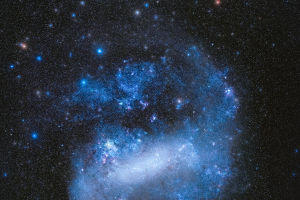
NGC 2403 is a fascinating spiral galaxy located in the constellation Camelopardalis, about 12 million light-years from Earth. It stands out for its active star-forming regions and its connection to the well-known Supernova 2004dj.
For skywatchers and astronomy enthusiasts, this distant galaxy offers an interesting glimpse into the structure and activity of another stellar system.
A Nearby Spiral Galaxy
NGC 2403 is also known as Caldwell 7. Despite its enormous distance from Earth, it is considered relatively nearby compared with many galaxies studied by astronomers. NASA describes the galaxy as roughly 80,000 light-years across, giving a sense of its impressive scale. Its spiral form contains stars, glowing gas, and dark dust spread across a wide disk.
The galaxy was discovered by William Herschel in 1788. It later became part of the Caldwell catalog, a collection of interesting deep-sky objects selected to complement more familiar catalogs of celestial targets. For observers in the Northern Hemisphere, NGC 2403 is best viewed during the winter months. It appears as an elongated, faint, fuzzy patch through binoculars or a telescope rather than the detailed structure shown in long-exposure astronomical observations.
Where New Stars Are Forming
One of NGC 2403's most interesting characteristics is its collection of H II regions. These are large areas of ionized hydrogen associated with the formation of new stars. Energetic young stars emit ultraviolet radiation that interacts with surrounding hydrogen, causing these clouds of gas to glow.
These regions are scattered through the galaxy and help give NGC 2403 a textured appearance. They also make the galaxy useful for studying how stellar nurseries develop. Instead of being a quiet collection of old stars, NGC 2403 contains areas where new generations of stars are forming from clouds of gas.
Astronomers have examined these regions using different types of observations, including visible and ultraviolet observations. Such studies provide information about the young stars within the galaxy and the environments in which they develop.
The Remarkable Supernova of 2004
NGC 2403 became particularly well known in 2004 after astronomers observed Supernova 2004dj. The stellar explosion occurred in the outskirts of the galaxy and became the brightest supernova seen in more than a decade at that time. At its peak, it reached an apparent magnitude of 11.2.
NASA's Hubble Space Telescope observed the galaxy on August 17, 2004, only about two weeks after the supernova was discovered. The observation showed the bright stellar event alongside star clusters and star-forming regions within NGC 2403.
Supernova 2004dj was classified as a Type II supernova, produced by the explosion of a massive star. NASA's observations noted that the star may have been around 15 times as massive as the Sun. The explosion also offered astronomers an opportunity to study the behavior of massive stars at the end of their lives.
A Rewarding Target for Skywatchers
For amateur astronomers, NGC 2403 offers an appealing challenge. Its magnitude of 8.9 means that dark skies and appropriate optical equipment can make a significant difference. Through a telescope, the galaxy generally appears as a soft, elongated patch, while detailed astronomical observations reveal much more structure.
Its position in Camelopardalis also gives observers a reason to explore a less familiar part of the sky. Finding it can become a satisfying exercise in star-hopping and deep-sky observation, particularly for those building experience with galaxies beyond the Milky Way.
NGC 2403 stands out because several interesting features come together in one distant galaxy. It is a large spiral system with active star-forming regions, a long history of astronomical observation, and a memorable supernova that became an important subject for study.
For anyone building a list of remarkable cosmic targets, NGC 2403 offers both an observing challenge and a fascinating scientific story. Its faint appearance through amateur equipment is only the beginning; beyond that small patch of light lies a galaxy filled with stars, glowing hydrogen clouds, and evidence of stellar activity unfolding millions of light-years away.