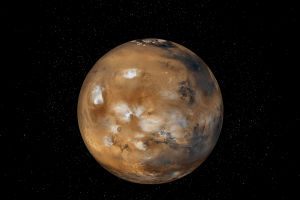
Mars appears cold and dry today, yet its surface preserves compelling evidence of a wetter past.
Ancient valley networks, lake basins, channels, and deltas reveal that flowing water once played an important role in shaping the planet.
Scientists now understand that Mars did not lose its water through a single event. Instead, water followed several pathways over billions of years. Some escaped into space, while other amounts became frozen, moved underground, or became chemically bound within minerals.
Evidence of Ancient Water
Mars’ landscape contains extensive signs of past water activity. Branching valley networks were carved by flowing water, while ancient basins and sediment-rich deltas indicate that lakes once existed in several regions.
Scientists are still investigating how warm and wet Mars became and how long favorable conditions lasted. Conditions were unlikely to have been identical everywhere, with different regions experiencing water under different circumstances and at different times.
As the planet evolved, persistent surface liquid water became increasingly uncommon. Much of the remaining water was eventually preserved as ice, stored beneath the surface, or incorporated into water-bearing minerals.
A Changing Atmosphere
Mars once had a substantially thicker atmosphere than it does today. Over geological time, atmospheric material escaped into space, reducing surface pressure and making conditions less favorable for persistent liquid water.
As pressure declined, surface water became more likely to freeze, evaporate, or move into the subsurface. Some water vapor also reached the upper atmosphere, where ultraviolet radiation could split water molecules into hydrogen and oxygen.
Hydrogen is particularly important because its low mass allows it to escape Mars more easily. Once hydrogen is lost to space, the water molecule from which it originated cannot be restored through the same process.
Water That Stayed Behind
Space was not the destination for all of Mars’ ancient water. Evidence from the Martian crust indicates that substantial amounts remain in different forms.
Water can be preserved as underground ice, move through subsurface environments, or become chemically incorporated into minerals during interactions between water and rock. These mineral deposits provide valuable evidence of ancient environments in which water was present.
Mars’ dry appearance therefore represents only part of the story. Its ancient water was divided among several reservoirs, with some permanently leaving the planet and some remaining within its surface and interior.
The Magnetic Connection
Mars’ magnetic history is also relevant to its atmospheric evolution. Geological evidence indicates that the planet once possessed a global magnetic field generated by an internal dynamo. That global field is no longer active, although localized magnetic fields remain preserved in parts of the crust.
A planetary magnetic field can influence how the upper atmosphere interacts with the solar wind, a stream of charged particles flowing from the Sun. After Mars’ global dynamo ceased, its interaction with the solar wind changed.
This does not mean that the loss of the global magnetic field alone removed Mars’ water. Atmospheric escape is a complex process involving several mechanisms, and magnetic conditions are only one part of the broader picture.
The Solar Wind’s Influence
The solar wind interacts directly with Mars’ upper atmosphere and can contribute to the loss of atmospheric particles. Charged particles and other atmospheric material can be accelerated away from the planet through several processes.
The effect becomes significant when measured across geological timescales. Even gradual atmospheric loss can produce major planetary changes when it continues for billions of years.
A thinner atmosphere then affects conditions at the surface. Lower pressure makes stable liquid water more difficult to maintain, reinforcing the long-term shift toward the cold, dry environment seen today.
Sunlight and Hydrogen Escape
Solar radiation provides another important part of the story. Water vapor that reaches the upper atmosphere can be broken apart by ultraviolet radiation, producing hydrogen and oxygen.
Because hydrogen is so light, it can escape into space much more readily than heavier atmospheric constituents. Scientists can study the relative amounts of hydrogen and deuterium in Mars’ atmosphere to investigate the planet’s history of water loss.
This escape is not perfectly steady. Seasonal and orbital changes influence how much water vapor reaches the upper atmosphere and how efficiently hydrogen can escape. Mars therefore provides evidence of an active and changing atmospheric system.
A Gradual Planetary Transformation
Mars’ transition from a wetter world to its present environment was not caused by one sudden disappearance of water. It resulted from the interaction of atmospheric evolution, solar radiation, surface conditions, geological processes, and atmospheric escape.
As the atmosphere thinned, persistent surface water became increasingly difficult to maintain. At the same time, water was redistributed into ice, underground reservoirs, and minerals, while another portion gradually escaped beyond Mars.
The loss of the global magnetic field may have influenced this evolution by changing the planet’s interaction with the solar wind, but it was not the only factor involved. Mars’ transformation reflects the combined effects of processes operating over immense periods of time.
Mars’ transformation was a gradual planetary process rather than a sudden disappearance of water. Over billions of years, atmospheric loss, solar radiation, changing surface conditions, and interactions with the solar wind contributed to the planet’s evolution, while some water remained frozen, underground, or preserved within minerals.
The ancient valleys, lake deposits, and water-altered rocks found across Mars preserve evidence of this remarkable change. Studying them helps scientists understand not only how Mars evolved, but also how planetary environments can change over immense periods of time.