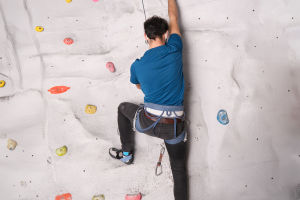
Climbing is as much about technique as it is about strength. Learning to move efficiently can save energy, prevent falls, and make even challenging routes feel manageable.
Below are key techniques every beginner should master to climb smarter, not harder.
1. Fundamental Movement Exercise
Stand up, face a wall, and hold both arms straight overhead.
Now, keeping your arms in place, twist your left hip clockwise toward the wall. Your left hand will rise noticeably higher without the arm moving at all.
This exercise demonstrates the core principle of climbing: using the lower body to extend and position the upper body rather than relying solely on arm strength. Every movement principle for beginners flows from this single insight.
Leg muscles — the quads, hamstrings, and glutes — are significantly larger and stronger than arm muscles. A climber who pushes with the legs while using the arms primarily for balance can climb longer without fatiguing. The arms will fatigue and "pump out" (become exhausted), but the legs almost never will.
2. The Contralateral Rule: Opposite Hand, Opposite Foot
Contralateral movement means when you pull with your left hand, your weight-bearing foot should be the right, and vice versa. This creates diagonal body tension, increasing stability and preventing the “barn door” effect — swinging away from the wall when only one side is loaded.
Using the same-side hand and foot together removes this opposing tension and can lead to falls. Practicing contralateral movement on easy routes ensures it becomes automatic on harder climbs.
3. The Flag: When There’s No Foothold Where You Need One
Flagging solves the contralateral problem when no foothold exists on the opposite side. Press the free leg against the wall — even without standing on it — to create counterbalance.
The flagged leg twists the hip toward the wall, stabilizes the body, and prevents swinging. On overhung terrain or when reaching far sideways, flagging is highly effective and energy-efficient.
4. The Rock Over: Moving Across, Not Up
Beginners often try to climb upward when lateral movement is needed. The rock over involves placing a high foot, moving your hip over that foot, transferring your weight, and then standing up.
Moving upward before positioning the hip over the foot puts all the load on the arms. Correctly executed, the movement becomes a leg press rather than an arm pull, conserving energy and improving control.
5. The Drop Knee: Turning a Hard Position Into an Easy One
Step onto a hold with your toe, then rotate the knee downward and inward toward the body’s center. The knee drops while the foot stays on the hold.
This rotation twists the hip into the wall (raising the arm without bending it), shifts weight to the opposite side, and locks the legs into a stable structure. Moves that seem strength-dependent often become manageable and resting after applying a drop knee.
6. Three Feet Per Hand Move
Beginners often move their hands first, then shuffle their feet — the wrong sequence. The recommended practice is three foot moves for every one hand move.
The feet determine what the hands can do. Placing feet first positions the arms for efficient pulls along the wall rather than against rotational forces. Practicing this builds the habit of treating footholds as actively as handholds, which distinguishes experienced climbers from beginners.
By internalizing these movement principles — leading with the legs, mastering contralateral balance, and practicing techniques like flagging, rock over, and drop knees — beginners can climb more efficiently, conserve energy, and develop a strong foundation for advanced routes. Consistent practice transforms challenging climbs from exhausting battles into controlled, strategic movements.