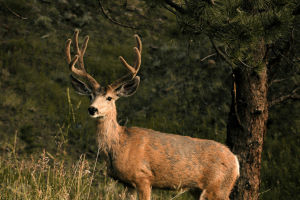
When people imagine how a deer sees the world, they often assume it’s similar to human sight—just sharper in the wild. In reality, the visual system of a deer is built for survival in ways that differ dramatically from ours.
From nearly panoramic awareness to an unusual sensitivity to motion, a deer’s eyes reveal a specialized design shaped by constant exposure to predators and shifting light conditions.
A Wide-Angle View of the World
One of the most striking features of deer vision is their field of view. Because their eyes are positioned on the sides of their head, deer can see almost everything around them without turning. Their visual range can approach 300 degrees, far exceeding the roughly 180-degree field humans experience.
This wide coverage allows a grazing deer to monitor its surroundings while keeping its head down. However, this advantage comes with a trade-off: limited depth perception directly in front. To compensate, deer often move their heads slightly from side to side, helping them gauge distance through shifting perspectives.
Motion Over Detail
While humans rely heavily on sharp focus and fine detail, deer prioritize detecting movement. Their retinas are packed with rod cells—light-sensitive structures that excel at picking up motion and low-light changes. This makes even the slightest flicker in the environment noticeable.
A still figure may go unnoticed if it blends into the background, but a sudden movement instantly draws attention. This is why hunters and wildlife observers often emphasize remaining motionless rather than relying solely on camouflage. For a deer, motion is far more alarming than color or shape.
Limited Color Perception
Contrary to popular belief, deer are not completely color-blind. However, their color vision differs significantly from humans. Deer possess what is known as dichromatic vision, meaning they primarily detect short and middle wavelengths—blues and greens. They struggle to distinguish longer wavelengths such as red and orange.
This means a bright orange jacket, which appears vivid to humans, may look dull or grayish to a deer. On the other hand, blue tones can appear unusually bright to them, standing out sharply against natural surroundings. This unique color sensitivity is closely tied to their environment. Forests and grasslands are dominated by greens and blues, making those hues more relevant for detecting subtle changes.
Superior Low-Light Vision
Deer are most active during dawn and dusk, periods known as crepuscular hours. Their eyes are specially adapted for these low-light conditions. A reflective layer behind the retina, called the tapetum lucidum, enhances their ability to gather and reuse available light.
This structure is responsible for the glowing effect seen when headlights catch a deer’s eyes at night. It essentially gives light a second chance to be detected, significantly improving visibility in dim environments. In addition to this, deer pupils are elongated horizontally, allowing more light to enter from the horizon. This is particularly useful in open landscapes where threats may approach from a distance.
Ultraviolet Sensitivity
One of the more surprising aspects of deer vision is their ability to perceive ultraviolet (UV) light. While invisible to humans, UV wavelengths can reveal patterns and contrasts that would otherwise remain hidden. For example, certain fabrics, detergents, and even natural scent markings reflect UV light. To a deer, these reflections can stand out dramatically. This ability likely aids in communication and environmental awareness, giving them access to visual cues beyond human perception.
Blind Spots and Behavioral Adjustments
Despite their impressive field of view, deer do have blind spots—primarily directly behind them and a small area in front of their nose. These gaps influence their behavior. When a deer senses uncertainty, it may turn its head or reposition its body to bring potential threats into view.
This constant scanning behavior is not random; it’s a direct response to the limitations of their vision. By combining wide-angle sight with frequent head movement, deer maintain a nearly continuous awareness of their surroundings.
Vision in the Context of Survival
A deer’s visual system cannot be understood in isolation. It works in tandem with acute hearing and a powerful sense of smell. While their eyesight excels at detecting motion and low-light changes, it is not designed for detailed inspection at long distances. Instead, deer rely on a layered defense strategy: eyes to detect movement, ears to pinpoint direction, and scent to confirm danger. This combination allows them to react quickly, often fleeing before a predator is even fully visible.
Understanding how deer see offers more than just biological insight—it changes how we interpret their behavior. What might appear as cautious or erratic movement is actually a finely tuned response to a world filled with subtle signals.